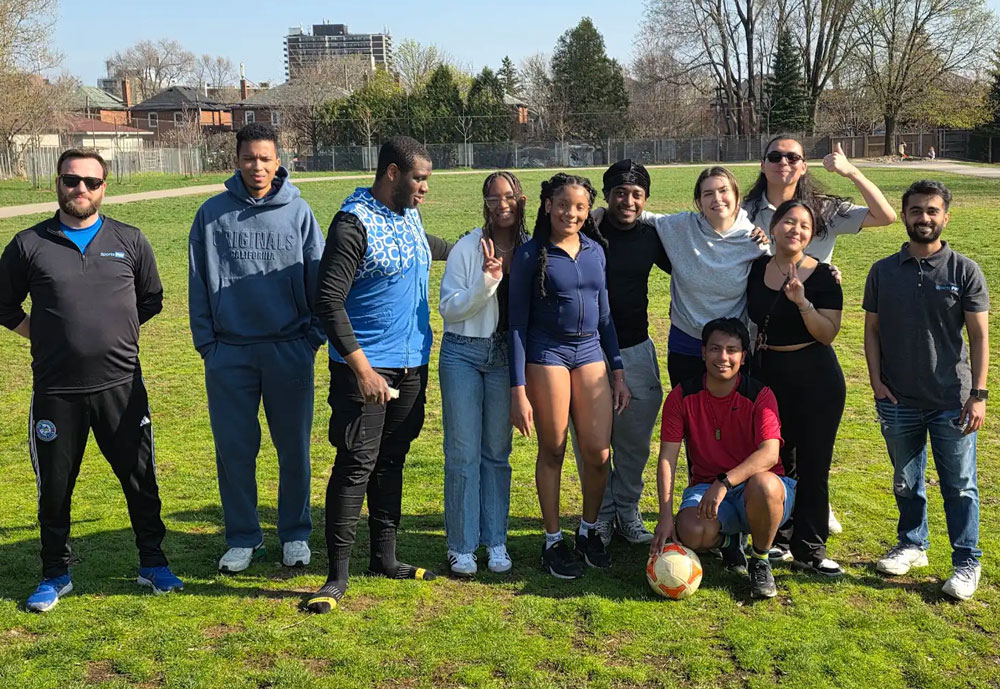
Sportspay Foundation was proud to kick off its support of the FCJ Refugee Centre Youth Program with a soccer session this April — the first in a series of planned events.
The FCJ Refugee Centre has been serving refugees and others at risk due to their immigration status for 35 years, offering services ranging from settlement support and legal referrals to counselling and public education. Within that broader mission, the Youth Network stands out as a vibrant, youth-led program that has supported newcomer youth for the past 14 years.
Open to youth aged 13 to 30 — regardless of immigration status, gender identity, language, or background — the program creates a welcoming and inclusive environment for young newcomers navigating life in Canada.
For two hours every Wednesday afternoon, the FCJ Youth Network becomes more than just a program. It transforms into what Anna Killham, the Centre’s Anti-Human Trafficking Youth Worker, describes as a “brave space” — a place where newcomer youth gather not only for support, but also to lead, create, be heard, and grow together.
“The Youth Network is really shaped by the young people themselves,” Anna explains. “We support them, but they are the spirit of the network. It’s about giving them the space and opportunity to challenge themselves, build community, and feel ownership over their environment.”
A Community Built by and for Youth
Every week, youth travel — sometimes up to two hours across the Greater Toronto Area — to attend the sessions. For many, the journey reflects just how valuable the space and sense of connection have become.
“A lot of the youth we work with came to Canada as unaccompanied minors, without parents or guardians,” Anna says. “They’re starting over, often without any connections here, and trying to navigate complex systems on their own. Their need for community is huge.”
The FCJ Youth Network is remarkably diverse, bringing together participants from all over the world. Despite differences in language and lived experience, the program fosters a strong sense of belonging.
Beyond the weekly meet-ups, the group organizes workshops, outings, and advocacy initiatives — everything from résumé-building sessions and film screenings to craft workshops, demonstrations, and fundraising garage sales organized in collaboration with the surrounding neighbourhood.
“There’s a strong connection with the local community,” Anna notes. “We host an annual street party with performances, dance lessons, activities for all ages, and food prepared by residents of the transitional housing program to celebrate and share the culture of our truly ‘Diverse Residents, One Community’ theme. It’s a chance for neighbours to meet the FCJ community and support the work we’re doing.”
The Centre is located within the Oakwood Village and St. Clair neighbourhoods, areas known for their rich immigrant communities, including Portuguese, Latin American, Caribbean, and many other cultural backgrounds.
Addressing Serious Challenges
While the environment is welcoming and creative, the challenges facing many youth participants are significant. Many experience isolation, language barriers, financial stress, and precarious employment.
Anna’s role focuses specifically on raising awareness around human trafficking and labour exploitation — issues that disproportionately affect newcomer youth, especially those without stable immigration status.
“Young people might be working temporary jobs or navigating language barriers, which can make them more vulnerable,” she explains. “Sometimes people are not aware of, or able to recognize, red flags like withheld pay or unsafe working conditions.”
Through monthly workshops and initiatives such as digital literacy projects — where youth create videos identifying signs of exploitation — the program equips participants with tools to protect themselves and support others.
“It’s a heavy topic,” Anna says. “But it’s a reality that many people face. So we address it head-on and focus on youth-led advocacy and prevention.”
The Power of Play
Amid these serious conversations, the FCJ Youth Network also prioritizes joy, movement, and healthy living. Over time, participants identified a need to actively support mental health through exercise and community-building activities. Many expressed a strong interest in soccer.
“They had been asking for a football (soccer) session for a while,” Anna recalls. “There was a clear desire to combine exercise, mental health, and community-building.”
That opportunity came through the Sportspay Foundation, which donated sports equipment including soccer balls, basketballs, and Frisbees. Sportspay staff members Will and Alish also led the soccer session, guiding the group through warm-ups and basic skills before refereeing the spirited match that followed.
Rather than hosting the activity indoors, the group took advantage of a nearby public park on one of the first warm, sunny days of the season.
“There were about 15 of us,” Anna says. “We started with a warm-up and then just had a casual game. It felt very organic.”
What stood out most wasn’t only the game itself, but how naturally everyone connected through it.
“Football is such a global sport,” she explains. “For many of the youth, it’s something they grew up with. You don’t need much — just a ball and something for goalposts — and suddenly, you’re connected.”
Many participants revealed impressive talent on the field. The session was informal, mixed-gender, and full of energy, with more women and gender-diverse participants than men taking part. The group also had the chance to try the donated Frisbees, which was a new experience for some.
“The session actually went longer than planned,” Anna says. “No one wanted to leave.”
More Than a Game
The afternoon captured something essential about the Youth Network’s mission.
“It wasn’t just about playing soccer,” Anna reflects. “It was about being outside together, supporting each other, and building those group dynamics in a different way.”
One youth participant shared:
“The soccer day completely changed my mood because I wasn’t feeling well that day. I thought doing something outside with friends could help change my perspective. Playing outside was so helpful for my mental health and physical well-being.”
In a program where many youth carry heavy responsibilities and difficult experiences, moments like these offer balance — a chance to relax, connect, and simply have fun.
At the same time, they reinforce something even deeper: a sense of belonging.
“When you see them laughing, working as a team, and encouraging each other, it shows how important these opportunities are,” Anna says. “It strengthens the community they’re already building every week.”
Looking Ahead
As the FCJ Refugee Centre continues to expand its programming — including exploring hybrid options to reach youth outside the downtown core — partnerships like the one with Sportspay Foundation play an important role.
But for Anna, the heart of the work remains unchanged.
“This space exists because of the youth,” she says. “They bring the ideas, the energy, and the leadership. We’re just here to support that.”